Sakezushi 酒ずし
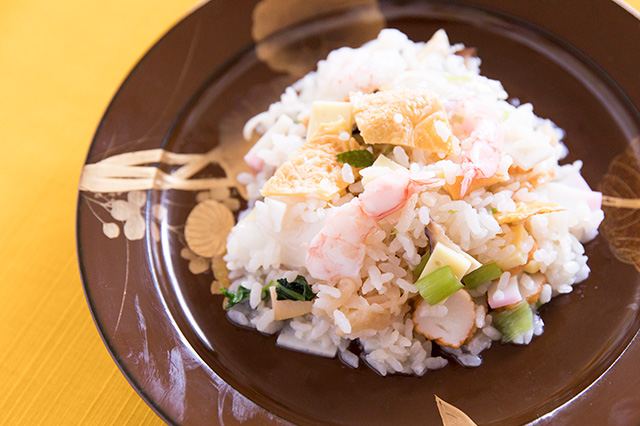
| Prefecture | Kagoshima (鹿児島県) |
|---|---|
| Region | Kyushu & Okinawa |
| Japanese name | 酒ずし(さけずし) |
| Reading | Sakezushi |
| Home area | All within the province. |
| Main ingredients | (Whistling) |
History and Origins
The "Drinking" is said to have a history from the Edo. When Master Oshima, who was the master of the Hanaoka festival, left the wine in his bowl together to serve the remaining feast, it was said that the next day it began to sprout and produce a delicious aroma. It's like a rice cooked with wine, sea or mountain, seasonal food, and a dish made with a "press" made by a cook for half a day. What is essential to "drunk" is the local wine. The process of making wines is narrowed by adding lye to it, and this process has made it more durable, so it has become called an ash holder. In Kagoshima Prefecture, they use it as a cane, and they drink it as a soft drink. Because of the mild climate, the Kagoshima Prefecture used to be poor in making wine, but instead it was very good in making this ash. To make them without a fire once, they are not destroyed by the acid, organic and mineral content, but they are said to produce a deep taste of "drunking."
When It Is Eaten
"Drinking" used to be a feast in spring when you could eat at the flower table. We make each of our spring foods, such as Thai, oak, tree sprouts, and so on, in good preparation and in luxury. Now it's a hard day to make, so it's often hard to eat, but when you're having a celebration, or when you're a crowd, you're being combined with various seasonal diets.
How It Is Eaten
I'm going to make sure that I have about ten kinds of tools, such as dried root, dried rice, tais, tie, shrimps, and I'm going to throw wine in a bowl of rice. I repeat this from two layers to three layers, and then place the last of the tools on top of the top, and then place the heavy stones on top of it, and then lay them half a day and let them insulate. After that, I'd like you to divide it into dishes so as not to tear down the layers as much as possible. You can still eat this, but you can eat it with more ash on your preference. The amount and ingredients of local liquor vary from home to store and from region to area and enjoy a variety of tastes.
Recipe — Serves 10
Ingredients
- 5 cups rice
- 5 cups water
- 5–6cm dashi kelp
- 30 g dried daikon radish
- 5 dried shiitake mushrooms
- 5 butterbur
- 150 g bamboo shoot
- 75 g carrot
- 4 egg
- 1/2 sea bream
- 10 shrimp
- 100 g aburaage (fried tofu) (satsuma-age (fried fish cake))
- 150 g kamaboko (fish cake)
- 150 g こがやき
- sansho leaves, to taste
- Condiments: mitsuba, to taste
- Mix: 3 cups local sake
- Mix: 1 tsp salt
- Mix: 1/2 tbsp sugar
- Mix: 1 tbsp light soy sauce
- Mix: 1 tbsp local sake
- Mix: 1 tbsp sugar
- Mix: 2 tbsp dark soy sauce
- Mix: 1 tbsp local sake
- Mix: 1 tsp light soy sauce
- Mix: 1/2 tbsp local sake
- Mix: a pinch salt
- Mix: 1/4 tsp salt
- Mix: 1 tsp sugar
- Mix: 1 tbsp local sake
- Mix: a pinch salt
- Mix: 1/2 tbsp local sake
- Mix: 1/4 tbsp salt
- Mix: 1/2 tbsp sugar
- Mix: 1 tbsp local sake
- Mix: 1/2 tsp potato starch
- Mix: 1 tbsp vinegar
- Mix: 1/2 tbsp sugar
- Mix: 1/4 tsp salt
- Mix: 1 tbsp vinegar
- Mix: 1/2 tbsp sugar
- Mix: 1/4 tsp salt
Method
- The rice is served in the same amount of water, and then poured in the same amount of water.
- The main root is water, taste it in B, and cut it to the length of one centimeter. The dried clay is brought back in water, boiled in boiling water, tasted in C, boiled and cut until the juice is gone. The wipes are boiled and peeled, but with soup and D, they are colored and boiled and cut to the length of one and a half centimeters. Cut the kite into one-inch lengths, and boil it with boiling water (not enough juice) and taste lightly E and boil it. Carrots are cut short and cooked with F. The eggs are broken, add G, make a fried egg, and cut into spirals. Thailand is put down on three pieces of salt, laid off its skin for about an hour, washed the vinegar, and soaked in H's sweets. The shrimp peels the shell, takes the spine, cuts the cucumbers, and then boils them with a quick boil, opens them up and dips them in the sweets of I. I'll give you a short book of five and a half centimeters long.
- I'll put A together after the rice is often cold.
- I'm going to put three bowls of wine on the rice bowl, and put three bowls of rice in a two-inch thickness, dry roots, carrots, scatterers, rice on top of it, scatter rice on top of it, tie, shrimp and tree sprouts, and so on.
- We can use local wine to shake the lids and place the scapshesite on the table for a few hours.
- I'll take all the tubs and cut them. I can get rid of the spices.
Dish data: Ministry of Agriculture, Forestry and Fisheries (MAFF), “Uchi no Kyodo Ryori” (Our Regional Cuisines) database, used under the Public Data License (PDL1.0); translated and adapted from the Japanese original.