Sanpeijiru 三平汁
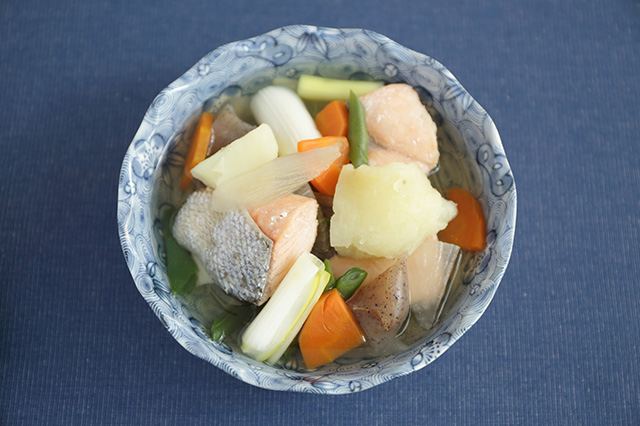
| Prefecture | Hokkaido (北海道) |
|---|---|
| Region | Hokkaido |
| Japanese name | 三平汁(さんぺいじる) |
| Reading | Sanpeijiru |
| Home area | All over the country. |
| Main ingredients | It's not just the meat. It's the meat. |
History and Origins
The "Schime soup" is a local dish made of salted fish, such as saxe, herring, and carrots and large roots, which are cooked together. The name "Tse-Long" comes from various theories. There are other theories that come from eating the stewed juice from the home of a fisherman named Saito Shirai, and because of his love for it, are derived from a dish called "Tse-Tree" and a dish that comes from a deep dish called the Kota-kun. It is estimated that it had been eaten for over 200 years, and in the late Edo record, there is a record of "Treeji" in the "East of the Sun." The "Schime juice" cooks raw fish stored in salt and salt with vegetables and tastes them with only the salt of the fish. Although sometimes associated with the "Sacrifice Cauldron" that is eaten with the same chopsticks, unlike the "Sacrifice Cauldron" that uses raw mushrooms in the taste-sing pot, the "Singing Cauldron" is characterized by the use of salted chopsticks. The fish and flavors we use vary from region to region. In the Tohoku and the East, salt pomegranates are used, but in the North, salt wax is also used. There is a "salt" with salt rose and tastey salt pomegranates, which are mainly salted and tastefully seasoned with mustard.
When It Is Eaten
It is often eaten during cold winter months, and it warms the body from its core. It is often eaten at home, and serves as a winter standard for Hokkaido.
How It Is Eaten
After the soup is served with the sauce, the fish's salted or boiled rice is cooked with the vegetables. Fish used are often used as snacks, cod, and herring, vegetables are used in carrots, radish, long hair, potatoes, and so on. Cooking fish heads and bones together adds to the flavor. There are various tools to be put in the home. There are taste buds, sesame oil, wines, and so on.
Recipe — Serves 4
Ingredients
- to taste () salmon
- 160 g potato
- 80 g daikon radish
- 30 g carrot
- 30 g green beans
- 30 g long green onion
- 30 g burdock root
- 60 g konnyaku
- 3 cups kelp dashi stock
- 1 tsp mirin
- a pinch salt
- a pinch shichimi seven-spice chili
- 1 tsp sake
Method
- The salmon cleans the salt and cuts it into a three-inch cut.
- The potatoes are cut in half, the radish and carrots are cut in half, the fish is cut in half, and the potatoes are torn in half.
- It's made from a dish made of rice and vegetables, and then put the garlic in the sauce, and add a soft sauce, a salad, and a pumpkin, and a little salt, and then add a half an inch of steam to the bowl.
- I'll cook the peppers on a tri-heavy plate, and I'll serve the pepper.
More About Sanpeijiru
Miyumi soup is Hokkaido native dish. It's a good winter dish with corn, carrots, and potatoes.
It is often mixed with stone-hunting pots, which are also made of leather, but while the stone-hunting pot tastes good, the taste of the sesame juice is only the salt that fish contain.
Description
In addition to cutting a salt bowl, sometimes you can add ice cream and other cherry peppers. In some areas or families, you may add extra-stuff vegetables or add wine and taste.
It is said that since the early Shogun, the Japanese taste has become common at Hokkaido, they have added albino to the taste soup.
Local Colors
The Hokkaido roads are made of salt, salt bran, and saltdala in the north and east. In the Japanese Sea, citrusin is used. In the station's tinged-up area, the taste buds are called "silica" and salt stamen "salt." It is common to use a sieve, or a sashimi, or a sashimi, or a sashimi. And there's no soy sauce.
Origin of Name
The origin of the name "Treeki" is not well defined, but in the book "Saiji" by Akira, the jigigigi, wrote, "The children of the Kojiu" are called "to be the offspring of the young of the slave and to be made into a seed. However, this time, the sesame soup is boiled with fish's internal meat from fish and is quite different from what it is today. Even more, "Singing" is a soup that is boiled with a strong - smelling mountain dish such as yuja garlic, which has been in storage, and "Custrum" has been brought back to life with rice sauce, as well as the walra, which has been boiled to taste.
There are various theories about the "From the Name" of Miy sauce as follows.
When Master Matsuro's hunting master became hungry and asked him to eat at his fisherman's home, he was given a soup made from a raw material. It's the theory that it came to be called trio soup from where it was popular. To those who later came across the Sea of Tsugaru, Saito Saito, who was a member of the tribe of Shikoku, who had been on the island of Tsugaru, the theory of the origin of the juice that was worn on the back island was denied to have existed before Saito's time. It is thought that the original oak oak from Toda Koda was made from a three-bed dish. In the Ainese, the heart calls it "sampe." The theory that the "Sanpe's O'how" with its entrails is the origin of the "S three-song" and the origin of the third-song soup.
History
The record says that in Tohoku's account, the description introduced by the name "Sanhhee" is the oldest. Also described as "Tse-Tree."
Book of Tablets
Text adapted and translated from the Japanese Wikipedia article 三平汁 by its contributors, licensed CC BY-SA 4.0.
Dish data: Ministry of Agriculture, Forestry and Fisheries (MAFF), “Uchi no Kyodo Ryori” (Our Regional Cuisines) database, used under the Public Data License (PDL1.0); translated and adapted from the Japanese original.