Sanmazushi さんま寿司
| Prefecture | Nara (奈良県) |
|---|---|
| Region | Kinki |
| Japanese name | さんま寿司(さんまずし) |
| Reading | Sanmazushi |
| Home area | Isegawa village |
| Main ingredients | And I'm going to show you some of the things that I've learned. |
History and Origins
"Sumi-saki" is primarily passed on as a native dish for Yosakamura, Nara Prefecture Yoshino County. And "Sumi-saki" was an essential part of Hale's day and New Year's Day. The unspoiled is one of the oldest chopsticks, which is packed with salted fish and rice. As the fermentation continues, it is called "unable" from being "mature and ripe." Since "unspoken" was originally only a way to preserve fish for long periods of time, the rice was abandoned to supply the sprouts. However, in the city's days, they have cut down their ovulation period and have eaten rice with fish. Yoshizuzumura's "Saki" has different ways of making each village in the north and south. The way the North is made is to salt the Samma and then wash the salt with salt and wine, and then it is prepared with a bowl of salt and a bowl of water and salt, and it is left unsuspected. Although there are differences in how to make it, the salmon used uses a low-fat Samma that has been sub-soiled from late fall to early summer, down to Kumazubu. Sunma, which is made from Kunono, is small and has so much fat that it's ideal for saving foods such as "Somi" and others.
When It Is Eaten
The main thing is that you can eat it on New Year's Eve. It's said that many families would take out the long-term sanmas in the fall and take them out on New Year's Eve.
How It Is Eaten
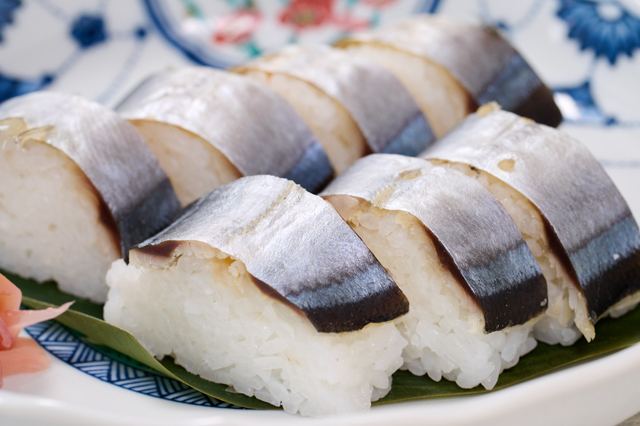
It's turned on its back and wrapped the salted Samma in vinegar and placed it on the rice that was caught in the size of a fish and then wrapped it in a wrap. It tastes like it's about two days from the next day, so it's about time to eat. We adjust the time when we can dip the sanma into vinegar according to our preference.
Recipe
Ingredients
- 5 Pacific saury
- 3 × 180 ml rice
- 750 ml water
- 37 ml sake
- kelp (konbu), to taste
- Mix: 125 ml vinegar
- Mix: 45 g sugar
- Mix: 55 ml vinegar
- Mix: 11 g sugar
- Mix: 6 g salt
Method
- Wash the rice, pour the cloth, put water and wine in, fill it for a couple of hours, and then take out the cloth and boil it. When you're ready to cook, I'll mix the seasoning B and cook the rice.
- I'll set up a fresh comma with less fat and tie it up. The metacarpals are also knifed at this time.
- Shake the three-steel salt-silver (over three-sized salt-sized weight of Sanma's weight) and wrap it in a flat container on its original shape and place it in the refrigerator for about a day and a night.
- Then, using a bone loss, we remove the bones of the abdomen, the lower bone, the lower bone, and the spine, and we clean the bones and scales that remain in the water.
- I'll pour a flavor A into the bat to the extent that it opens the sun and arranges it up and folds it. The time you keep in is half an hour and two minutes, and the vinegar's good-lookingness is adjusted according to your preference.
- When it's done with vinegar, we drain it up, we grab it up to the size of the rice, put it on top of the rice, and wrap it in a wrap.
- It's about time you ate the taste lightly, about the second day after the first day.
More About Sanmazushi
It's a local dish that is prepared mainly during celebrations and festivals.
A fallfish, in late October and late March, will go south for its eggs, but the fall swordfish in the south of the bear family is small and so faty that it is suitable for sushi. We open the Fallfish and lightly salt it. A fallfish put rice in a rectangle that fits in every square and then held it open with its head on and pressed it down, and it was a kind of pusher. The opening of a fall swordfish depends on the opening of a knife fish from its back, and the opening from its belly is different from the local. There are many sushi shops that specialize in selling this in Newmiya City and elsewhere. The perfume of the fall-scarlet fish is made of yuz, daisy and jabara. The condiment often has the congealed congeal. Although it was the station's valves in the Amitabian Express and the New Citadel Station, due to the withdrawal of the vendors and the reduction in the inside sales, only the JR's station outside Iseshima Station has been sold today in 2017.
Even in the area, they have been fed with autumn swordfish in rice, and they have not been fermented. This is another special product. This is probably older in origin. Some sushi stores have been selling things that have been fermented for more than 30 years. Now the rice and the fish are not left in any mold, but are turned into cucumbers.
In the mountain area, it is an important protein source, and uses salted Sammas, often eating at least three to one year later.
The former is classified as "quick" in the use of vinegar, and the latter as "immeasurable" by lye.
If the Sushi of the fall swordfish is the original form of Akashi Akira, the Bearsho's "Sumi Seshi" of Bear City refers to January 10 as "Sumi's Day."
Text adapted and translated from the Japanese Wikipedia article 秋刀魚寿司 by its contributors, licensed CC BY-SA 4.0.
Dish data: Ministry of Agriculture, Forestry and Fisheries (MAFF), “Uchi no Kyodo Ryori” (Our Regional Cuisines) database, used under the Public Data License (PDL1.0); translated and adapted from the Japanese original.