Home / Kagawa / Shimanochagayu
Shimanochagayu 島の茶粥
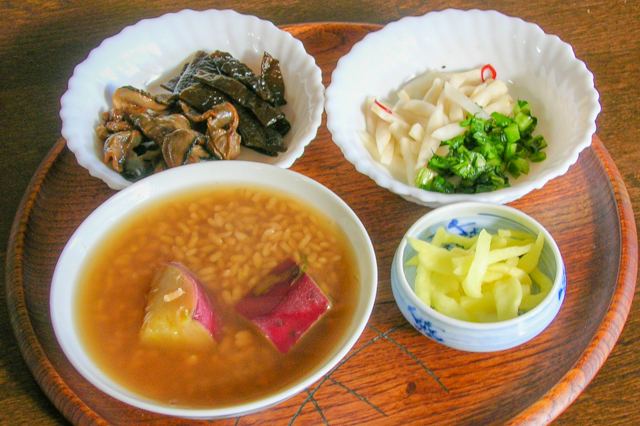
| Prefecture | Kagawa (香川県) |
|---|---|
| Region | Shikoku |
| Japanese name | 島の茶粥(しまのちゃがゆ) |
| Reading | Shimanochagayu |
| Home area | The salt islands of the Inland Sea. |
| Main ingredients | (Music) |
History and Origins
One of the salt islands in the Inland Sea is a volunteer island. In this small island, four kilometers around, breakfast used to be a cup of tea. The salt islands, where there are no rice fields, as well as those where there are no rice fields, have old tea and are still eaten by some island folk. Rice was a valuable commodity to sell and obtain, and tea was a means to "stretch" the rice. In those days, it was said that the king-in-law tea trade, the king-in-law, had gone to buy and sell tea to the best of knowledge. The process is done by boiling water in a bowl and boiling the Kochi Prefecture tea with a bowl of rice and poppy rice, and then boiling it for about 20 minutes. There's no seasoning flavoring at all, and the deep pussies of sashimi are the only flavors. Also, it is said that teacups are good for hot water, which contains a small amount of salt water that is unique to the island. From something like this, teacups are often eaten in this area. There are also teas in the cup, besides sashimi, which are made from Takashi and Takashi from Takashima, and there is a taste in each home with tea distribution and the ingredients in it. It's also called tea on the island.
When It Is Eaten
You can eat it through the year. I've been familiar with fishermen because they can easily make it, and they can easily eat it.
How It Is Eaten
We boil hot water in a bowl, boil it, add rice, and boil it for about 20 minutes. In other cases, you can add wheat, potatoes, onions and the rest of the New Year's sauces to be small and roasted. Materials vary from season to season and from region to household. Also, teacups are made in different ways by different families.
Recipe — Serves 6
Ingredients
- 1(2) 碁石茶
- 1.5 L–2 L water
- 1.5 × 180 ml–2 × 180 ml rice
Method
- The water in 5L2L is made to boil with sashimi. In Japanese tea, two commercial paper packages are used to produce dark colors. In the past, Ishishii tea was cheap, but now more houses are using such things as maki habu. There's also a story in Saito that he called Koshita tea a piece of crap. )
- When it is boiling, take out a cup of tea and add rice and half rice together. It's a heavy fire, and it's been boiling for about 15 minutes while making sure that rice is dancing in the pot. There's also a theory that old rice is good. (It's a time of season when the rice is not cut into three-inch cubes, but with a prehydration of water, or when the rest of the New Year is cut into small pieces.)
- When the rice is soft, it's done. Normally, I eat a soft cup of tea. Some people have a little steam and then eat, but it seems to vary according to their tastes. In addition to plating, such as rags, cucumbers, and plums.
Dish data: Ministry of Agriculture, Forestry and Fisheries (MAFF), “Uchi no Kyodo Ryori” (Our Regional Cuisines) database, used under the Public Data License (PDL1.0); translated and adapted from the Japanese original.