Tochimochi 栃餅
| Prefecture | Tottori (鳥取県) |
|---|---|
| Region | Chugoku |
| Japanese name | 栃餅(とちもち) |
| Reading | Tochimochi |
| Home area | We're going to have to do something about it. |
| Main ingredients | I'm a rice man. I'm a rice man. |
History and Origins
It's so hard to eat that it's so painful to eat and so intense to run a pain in the tongue. It is said that the wisdom and experience of the predecessors has given rise to a delicious way of eating and that old people have been eaten from the time of their long time. Once upon a time, in Yamamura, where rice was scarce, it was one of the most valuable foods. There are about one or two berries in the thick shell. In autumn they are ripe brown and they grow from three to four centimeters. It's a concordat fruit that looks like a silk plant and is harvested from October to November. The nut is rich in ingredients such as potassium, copper, manganese, Saponin, and tannin.
When It Is Eaten
In the local family, the Chinese are making a bowl of citrus as a boiling bowl for New Year's.
How It Is Eaten
Take a bite from the rice and taste it bitter, soak it up and round it up and eat it as a cucumber. It's a simple taste that can taste a unique bitter taste and pain, less sticky than rice. If you put it in a yuzu soup, you can pass it on and eat it.
Recipe
Ingredients
- 1–1.5 glutinous rice
- 500 g all (とち)
- Mix: 1 栃の実
- Mix: 1–2 木灰 (樫やくぬぎなどの堅木)
Method
- After putting the sieve in a bowl and pouring a lot of boiling water, we will be able to add a bowl of hot water.
- We're boiling water in the bowl and keeping it warm, and we're skinning it with the old two sheets of "Tochiki."
- I put the convex bowl in my bag and I put it in water for five or six days.
- I put the rice bowl in a bowl, put it in hot water, mix it well, and then cook the water. After that, I put the paste in the bowl at the rate of one ash per cup two and then mix it with boiling water. I'll cover the tub with a nylon and I'll leave it for two days. I'll put in a bowl with an old blanket and keep it warm. The other day, they mix well with sticks every hour. Three or four times.
- (Confirmation on board) If you bite the nut and stab the pistil and the tongue, then it's a good match. About three grains, or boiling or baking, if you try to crush them with your fingers, your core will be hard and you won't fit. I'm going to try to make a dumplings with a small amount of color.
- When you're not ready to go under the board (when you're not ready for it), wash the ashes of the sieve, pour the ashes again, pour boiling water, and re-re-re-set the plate. If the pot is missing, wash it well and put ashes on it.
- The rice is washed and soaked in water for eight hours. (It's shorter when it's hot and it's longer when it's cold)
- I have to cook rice an hour before the steaming, and I do a drain.
- When steaming rice, put it on top of rice from the beginning and steam it. The frozen ones will be frozen naturally.
- The steam is about half an hour long when it is steamed.
- I'll do it until the rice grain is gone and my skin is turned on.
- If you round it, you'll get about 55 at 1.5 grams.
More About Tochimochi
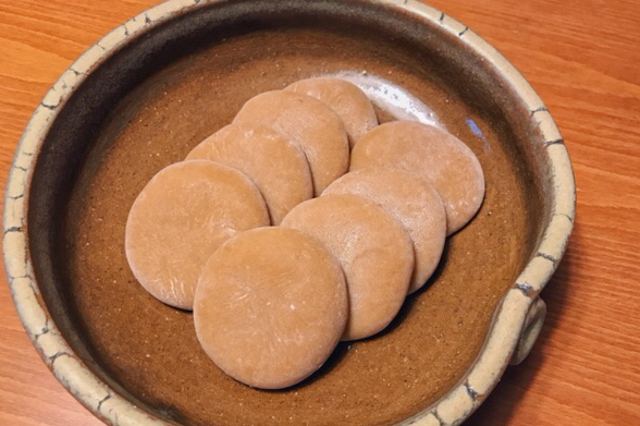
The citrus was soaked with rice and then boiled with it. It's yellowish and brownr than rice alone, and has fewer persistence, and has a peculiar bitterness and bitterness. In modern times, it is also sold as one of the native products of the whole country. Put sugar on it, wrap or wrap it around it, and stuff it into salt tea and so on.
Once the rice plant was an important food food for a mountain village where rice was scarce and used to be eaten from the time of the rope. Japan is the only eater in the world that takes out the pot from the bush. It takes more than half a month of time and advanced technology to get through the Ak. The taste is influenced by the quality of the ashes used in accumulatives and by the temperature control of the moment. The nuts are also sold in advance.
Text adapted and translated from the Japanese Wikipedia article 栃餅 by its contributors, licensed CC BY-SA 4.0.
Dish data: Ministry of Agriculture, Forestry and Fisheries (MAFF), “Uchi no Kyodo Ryori” (Our Regional Cuisines) database, used under the Public Data License (PDL1.0); translated and adapted from the Japanese original.