Sukozushi 須古ずし
| Prefecture | Saga (佐賀県) |
|---|---|
| Region | Kyushu & Okinawa |
| Japanese name | 須古ずし(すこずし) |
| Reading | Sukozushi |
| Home area | Whitestone Town |
| Main ingredients | rice. |
History and Origins
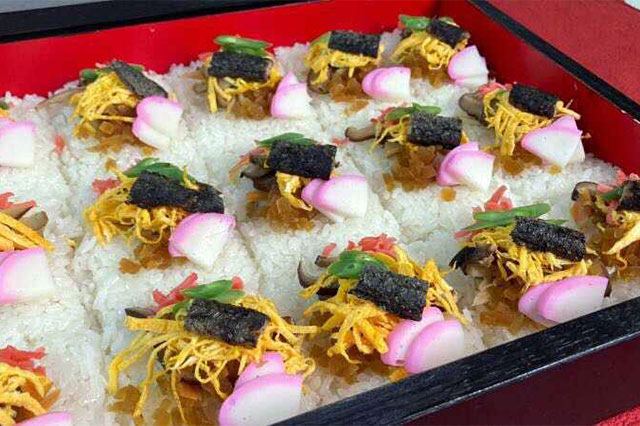
Whitestones on the clear sea are abundant in mountains, plain, seas, rivers and nature. In particular, Shiki Shirahara is a land built by frequent drying operations between the Middle Ages and modern times, and a agricultural suitable area for rice, wheat, and vegetables. It's said that rice has been trying to improve quality for many years in the past. According to tradition, over 500 years ago, the lord of the old Shikashi City district cared very much for the farmers in his area and devoted himself to improving the quality of rice. The value of it made it a reputation for being a "single rice" and a "dew rice" and making a reputation for being a nationally famous person. Thanks to the lord's love, the people are said to have used local sea and mountains to build and donate their wood. It is called the "Recenting of the Dead," and it has been passed on from mother to child, from child to grandson, and it is still an indispensable gift to celebration. The boxed style is distinctive and you can enjoy the simple taste of the local tools. Originally used as a tool to make a chicken roast, these days it's difficult to obtain, so it can be used by shrimps and coconuts.
When It Is Eaten
In the Kanashima area, people who came to the local temple and Japan's Kasakajijijijijijijijiji, were treated as a welcome welcome welcome welcome welcome home to their daughter's daughter. It's a local dish of pride that still serves guests at local festivals and celebrations.
How It Is Eaten
The rice is cooked with salt and roots. Add vinegar to the cooked rice, mix it with vinegar, and then pack it in a crate called "Nake." Cut into rectangles, cut them into pieces, cut them into pieces, cut them into pieces, such as talons, nazu, tadpole, and tassels, and silky thread eggs, and sweetly boiled cicada gou-nin. I've finished the carvings of three leaves and red pepper. Instead of roasting the dog, you can use a chicken or shrimp. I'm going to cut it with Ha Ni. Materials vary in seasons and in families, but the ocean's sea's rise in the clear sea and mountain's well-being are increasingly used.
Recipe
Ingredients
- 5 × 180 ml regular rice
- 0.5 × 180 ml glutinous rice
- 2/3 tsp salt
- Vinegar: 60 g sugar
- Vinegar: 1/2 cups vinegar
- Vinegar: 1 tsp salt
- 5 prickly (かば焼き)
- 30 g burdock root
- 30 g carrot
- 5 shiitake mushrooms (乾)
- Mix: 1 cups シイタケもどし汁
- Mix: 2 tbsp sugar
- Mix: 1 tbsp sake
- Mix: 2 tbsp soy sauce
- 3 egg
- 1 kamaboko (fish cake)
- as needed sayya window
- 1/3 Nara pickles
- as needed pickled red ginger
Method
- Rice is served, salt is added and cooked normally.
- I'll make vinegar to match.
- The platitudes clean themselves and cut them in half.
- Sea cucumbers are unwatered, cut, gobow, and carrots are short-knited.
- I'll boil the cucumbers with a sauce of citrus au citrus, and then I'll boil the gooey and carrots with the same sauce.
- The eggs are ground to powder and then turned into a silken egg. I'm going to steam up the mushrooms and cut them into 18 slices. I'll boil the cherry peas, cut them fine, cut them fine, cut the nada, cut the red pepper into rough slices.
- We've moved the cooked rice in two pieces, mixed it up with vinegar and cut it, mixed it carefully and spread it lightly. Cut into three sections, six by three, and place the tools on top.
Dish data: Ministry of Agriculture, Forestry and Fisheries (MAFF), “Uchi no Kyodo Ryori” (Our Regional Cuisines) database, used under the Public Data License (PDL1.0); translated and adapted from the Japanese original.