Home / Nagasaki / Kankoro mochi
Kankoro mochi かんころ餅
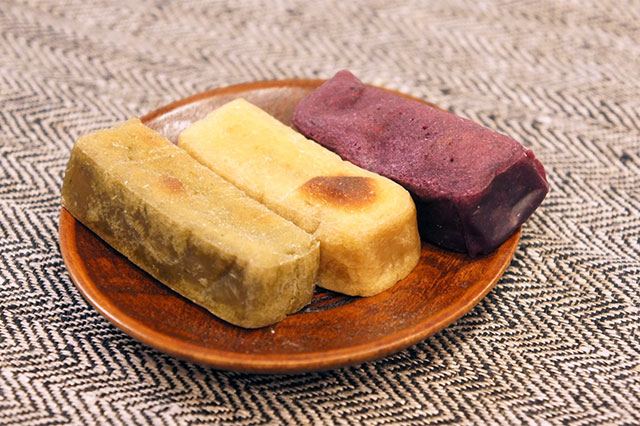
| Prefecture | Nagasaki (長崎県) |
|---|---|
| Region | Kyushu & Okinawa |
| Japanese name | かんころ餅(かんころもち) |
| Reading | Kankoromochi |
| Home area | Five Island |
| Main ingredients | I'm gonna put you on the table. |
History and Origins
"Kinji" is an old native food food for the Nagasaki Prefecture5 district. In the Gotshima area, the thin slice of the potato and the sun - dried one is called "C". If you mix this "crumb" with rice, it will produce a "crumb" In the past, it was made in each home as a winter preserve. It is said that it was because the whole family had enough even if they had fewer expensive rice. And yet, as one of the tales, the persecutions of the Edo were caused by the Christian people who went to the Five Island Islands and began to build them for food.
When It Is Eaten
It used to be home-to-home winter preservation. Now that it has become a special product of Nagasaki, including the Five Island district, products are sold from various manufacturers and are available to eat regularly and anywhere. Some local restaurants also offer them as fine food throughout the year.
How It Is Eaten
Originally, it was just a simple bowl with a sweet potato. In recent years, sugar has been added to the sweets and a combination of sides like Japanese sweets. The basic method of eating is to cut and burn sticks, but there are many ways of eating to match modern man's tongue, such as putting butter on the roast or leaning on it. And some of the products that are widely available have been made to enjoy the variety of looks and tastes, such as adding potato and lentils.
Recipe — Serves 4
Ingredients
- 3 × 180 ml glutinous rice
- 200 g dried potatoes
- 10 tbsp sugar
- 4 tbsp potato starch
Method
- Wash rice in water and let it soak overnight.
- Put the rice in the monkey for 30 minutes after it's swallowed.
- Add sugar with a pinch. (I'm gonna put some potatoes and lentils in for your pleasure)
- After the end of the day, I'll take it out on the table and form it into a mushroom mold. (If you put one piece of flour on it, it'll make it hard to rub.)
- I'll burn it in an oven toaster.
More About Kankoro mochi
Kankoro mochi (かんころもち) is a type of mochi commonly eaten in Kyushu and Okinawa, Japan. It is made by mixing partially boiled sweet potatoes into mochi.
Origin
"Kankoro", in Gotō's regional dialect, refers to thinly sliced, sun-dried sweet potato. Originally prepared as a non-perishable food for winter in the Gotō region, it has become a specialty, or tokusanhin, of Nagasaki Prefecture and is manufactured and sold throughout the prefecture.
Sweet potatoes can be grown on the Gotō Islands despite its lack of flat ground and abundance of barren slopes. Additionally, there is little difference between a good and bad harvest, and they are resistant to damage from typhoons, eliminating the risk of famine. These qualities have made sweet potatoes valued as a vital agriculture product supporting the economy of the Gotō Islands. Although it is unknown when sweet potatoes came to be cultivated on the Gotō Islands, it had become a crop grown by commoners by the Kanbun era (1661–1672), and in 1833, the Fukue Domain began to promote sweet potato cultivation in a dramatic shift from existing regulations. Sweet potatoes began to spread across the islands at the beginning of the Meiji era in the late 1860s, and by the Taishō era (1912–1926), it was the Gotō Islands' most abundant agricultural product.
Cultivation of sweet potatoes in Gotō would later slowly decline as their demand as an ingredient in shōchū and starch waned. However, many households still make kankoro mochi for the Japanese New Year to send to children and relatives who have left the islands.
Preparation
- Sweet potatoes are left in the sun for half a month to drain some of their moisture. The skin is peeled and the potatoes are cut into thin, round slices. After being boiled, the slices are dried in the sun. The finished product (kankoro) is then stored.
- Glutinous rice is washed, steeped in water for half a month, and then steamed.
- The kankoro is washed in a bucket or other container with hot water. A lid is placed on the container, and after allowing the kankoro to soak for a short time, it is then steamed.
- The steamed kankoro is placed into a mortar and mashed with a mochi hammer. The steamed glutinous rice is added and then thoroughly mashed. When factory made, a mochi pounding machine or mixer is used.
- The resulting mixture is transferred to a table and formed into semi-cylinders.
Characteristics
- Color ranges from green to greenish brown. Very sweet and stays soft even at lower temperatures.
- When made using traditional methods, it cannot be consumed without being fried unless mixed with anko and is also less sweet.
- Varieties include mochi mixed with yomogi or roasted sesame seeds.
- Unlike regular mochi, the glutinous rice in kankoro mochi, which keeps it together, will melt when cooked for even a short amount of time. Thus, care is needed when preparing it.
- Dissolves when simmered.
Text adapted from the English Wikipedia article Kankoro mochi by its contributors, licensed CC BY-SA 4.0.
Dish data: Ministry of Agriculture, Forestry and Fisheries (MAFF), “Uchi no Kyodo Ryori” (Our Regional Cuisines) database, used under the Public Data License (PDL1.0); translated and adapted from the Japanese original.