Home / Kumamoto / Asotakanazuke
Asotakanazuke 阿蘇高菜漬け
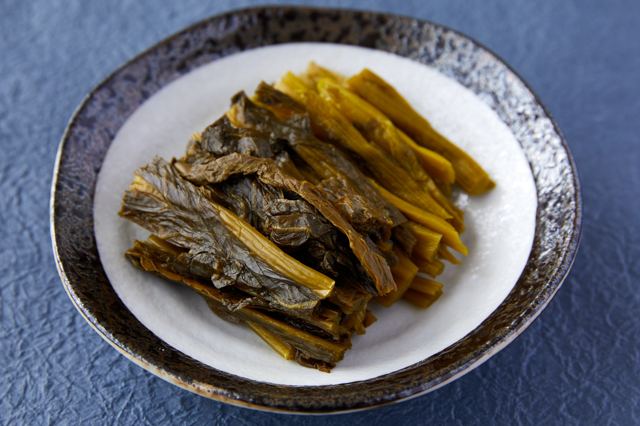
| Prefecture | Kumamoto (熊本県) |
|---|---|
| Region | Kyushu & Okinawa |
| Japanese name | 阿蘇高菜漬け(あそたかなづけ) |
| Reading | Asotakanazuke |
| Home area | Assistance City. |
| Main ingredients | Hatakes, salts, peppers. |
History and Origins
The "Autobe" is a traditional vegetable that grows in the cold climates of the resuscitation and volcanic ash. In the fall we sow seed, and in the cold of winter we will reap what has grown rapidly before spring in March and April. The thick stem at the time of the meal has a hard-knit part that is broken, and it is still made with hands and hands. That's why the harvest of the green vegetable is called the "Hujibeaki." Also, the sprouts are thin, soft, and sharp, so they have been boiled with salt and red peppers right after harvest. "Autobeaki" is a familiar dish, whether it's a table or a souvenir. There are some old-fashioned foods that are soaked and eaten in about three days and that take half a year to fertilize and enjoy the flavor of icicles and pics.
When It Is Eaten
The new ones were shallow during the harvest season in mid- March, and the way they were harvested and processed, and the way they lined up at the store, the windy poetry informs us of spring's arrival. Old-fashioned, a little salted and half-year-old icicled, comes out in fall.
How It Is Eaten
Besides enjoying yourself as a cucumber, they are used by many different dishes. The "gay" that mixs in rice with oil, roasts and peppers, especially in fine carvings, is known as the local dish. Other foods are eaten in a variety of ways, such as mushrooms, chahans, tasakos, whole bread, pasta and so on.
Recipe
Ingredients
- 10 kg hatabea
- 400 g(4%) salt
- a pinch chili pepper
Method
- I'm going to dip the raw vegetable in a lot of salt.
- If you pack it, you roll the rest of the salt and mix it alternately.
- We'll put a lid on it and a heavy stone on it. If the juice comes up on the lid, I'll clean it carefully every two days.
- After a week of stuff, I throw away the juice.
- If you want to preserve a peripheral procedure, add salt to the table for six months, as 6 percent of the vegetable.
- If you add 2 Others, you increase the salt level by 8%.
Dish data: Ministry of Agriculture, Forestry and Fisheries (MAFF), “Uchi no Kyodo Ryori” (Our Regional Cuisines) database, used under the Public Data License (PDL1.0); translated and adapted from the Japanese original.