Kurobo げたんは
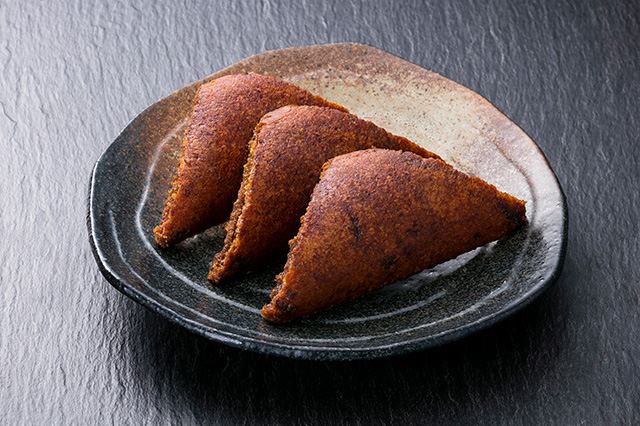
| Prefecture | Kagoshima (鹿児島県) |
|---|---|
| Region | Kyushu & Okinawa |
| Japanese name | げたんは |
| Home area | All within the province. |
| Main ingredients | Light powder, soda, black sugar. |
History and Origins
One of the local sweets of Kagoshima, which was made to serve as tea for those who gathered in the once - famous American cargo area. It is said that this unique name came to be called this way because it was a look similar to that of a dirt-stained subsoil tooth. And at that time, it was also called "Ezeki." The rich, black sugar flavor spreads into the mouth. For fabrics and surrounding coatings, black sugar is used for luxury. In Kagoshima Prefecture, black sugar was strongly rooted as a sweetener because, in the Edo days, the Japanese ruling over the kingdom of Chihuahua was the sole source of the black sugar, the monotony and the coniferous production of black sugar. It's said that the annual payment was recovered from rice, that it was used in black sugar, which was very expensive at the time, and that the finances had suddenly recovered by monopolizing black sugar. On the other hand, the island people were forced to put the production of black sugar ahead of the production of daily food, so they began to work their way around the harsh situation called black sugar hell. Over the course of this history, black sugar has been absorbed in Kashima's mainland, and along with it, various native dishes with black sugar have come into existence. From this background, it is thought that "the Great" was born as a sweet with black sugar and was introduced to the common people.
When It Is Eaten
Especially during the year, they are eaten mainly as pets.
How It Is Eaten
In flour and soda combined with flour, you add water - melted black sugar and mix it well. Spread the fabric on the oven roof and cook it for about 20 minutes. If you take it out and get a mild fever, you cut it into a two-sided triangle and eat it with a black sugar honey. On the surface, the dark sugar stains on the fabric of the hardness and the black sugar stains on the fabric as time goes by. The point is to keep the dark sugar on the surface dry and sticky.
Recipe
Ingredients
- 500 g cake flour
- 2.5 tsp baking soda
- 200 g brown sugar
- 200 ml water
- Mix: 300 g brown sugar
- Mix: 150 ml water
Method
- The flour and the soda shake together.
- (When water is in the black sugar, melt it and cool it down when it's hard to melt it.)
- Put two in it and mix well until the powder is gone.
- The size of the panel is covered with Cooking Paper, and the 3 is spread with hand-to-hand water to make it even.
- I'll burn it in a 170-degree oven for about 20 minutes.
- The nectar ingredients are boiled together.
- When the heat is removed, cut the triangle and let the 6 go through.
More About Kurobo
Kurobō (黒棒) is a type of baked confectionery that has been traditionally made mainly in the Kyushu region of Japan.
Overview
The preparation method involves kneading and resting a dough made from brown sugar, eggs, flour, and baking soda, shaping it into sticks, and baking it in an oven. After baking, the sticks are cut to an appropriate length, coated with brown sugar or ginger syrup, and then dried. Locally, they are known as Kuronbō (くろんぼう) in the regional dialect.
Some variations use white sugar instead of brown sugar, producing a version called Shirobō (白棒).
Similar confections exist, such as Shiso Pan (紫蘇パン), which incorporates perilla leaves.
History
The origin of Kurobo is unclear.
Until the Meiji period, even the name had not been firmly established, and it existed as a common confection throughout Kyushu.
Today, wheat is still produced in Kyushu, and in the past, sugarcane cultivation and brown sugar production were also widespread in the region. It is commonly believed that farmers created Kurobō as a homemade confection using these local ingredients.
It has also been eaten since ancient times in Okinawa (Ryukyu), a major production area of brown sugar.
During World War II, Kurobō was consumed as a food supply by the Japanese military.
Because it was inexpensive to produce and easy to mass-produce, soldiers valued it as a precious source of sweetness.
Today, Kurobō is not limited to the Kyushu region but is sold throughout Japan.
Due to its affordable price, it is often classified as a type of dagashi (cheap traditional snacks), and it continues to be loved by modern Japanese people as a quick snack or portable food.
Main manufacturers
- Kurobo Confectionery - Kurume City , Fukuoka Prefecture
- Hashimoto Confectionery - Minamiseki Town, Tamana District, Kumamoto Prefecture
- Trio Foods - Yame City, Fukuoka Prefecture
Text adapted from the English Wikipedia article Kurobo by its contributors, licensed CC BY-SA 4.0.
Dish data: Ministry of Agriculture, Forestry and Fisheries (MAFF), “Uchi no Kyodo Ryori” (Our Regional Cuisines) database, used under the Public Data License (PDL1.0); translated and adapted from the Japanese original.