Kashamochi かしゃもち
| Prefecture | Kagoshima (鹿児島県) |
|---|---|
| Region | Kyushu & Okinawa |
| Japanese name | かしゃもち |
| Home area | I'll be back in a minute. |
| Main ingredients | It's not just the leaves. It's the leaves. |
History and Origins
"Imagination" is a dish made from a rice made from a rice sauce made in the Nami region. It is said that the rose is the leaves of the bear, and from this wrapping it has come to be called "The Grizzly." "I'm sorry," "I'm sorry," "I'm sorry," "I'm sorry." "I'm sorry." "I'm sorry. In the Sugiji region, it has been used to eat well, used as a herb for centuries, and also to remove its toxic effects from the smell. Also, it is said that the bear taquelin is also a plant of the pepper family, so it has a bacterial and insect-proof effect. It grows on its own everywhere in the Sushi district, and besides "I'm jealous," it also covers the bowl. It's a delight made of the wisdom of its predecessors, made from the black sugar, the leaves of the bear's branch, and the materials that are so highly effective that they can be found near you. It is said that in the Kumiko region, the leaves of the pinecone tree and the flavoring of each material add to the flavor, and it is sometimes referred to as the chrysanthemum and the kascha.
When It Is Eaten
Once eaten on March 3rd of the old calendar, we can now eat at any time. In spring, I'll take the reeds and freeze them and then wrap them up with bear-squeakelan leaves and moon peach leaves.
How It Is Eaten
Wash the rice in water, wash the dirt, and boil it in hot water with soda. The rice bowl is soaked overnight and unhesitating. After cutting the water, and the boiled tassels, put them in mixers and like, paste them into paste, black sugar, rice powder, water, and then paste them. After washing it, wrap the dough in the leaves of the bear taquelan, which is about four inches long, and then soak them in a distiller for about 20 minutes. As the leaves of the bearquelan grow into the pot, the taste of the black sugar increases. When you eat, remove the leaves from the bear, and eat only the crumbs inside. When you become hardened, you can soak a little and eat in a soft state again.
Recipe — Serves 4
Ingredients
- 120 g() mugwort
- 1 tsp baking soda
- 150 g glutinous rice flour
- 160 g brown sugar (粉)
- 100 g sweet potato
- 80–100 ml water
- 5–6 クマタケランの葉
Method
- I wash the reed clean and rip the leaves off. I'll boil a lot of water and put a soda in it and then I'll boil it gently.
- When you boil it up, I'll give it a night's water, and spring's bowl that pulls out the pot is too small.)
- It narrows down.
- I'll boil and peel and crush the tadpole.
- I put three in (such as a speed cutter) and paste it into paste.
- Put four into it and then paste it into another paste. Black sugar, rice powder, and water are added to paste all the ingredients.
- I'll wash the leaves of the bear-takerlan and cut them into about two feet long.
- She wraps it around a leaf of the bear taqueline with her hands to the size that is easily eaten.
- I'll put it in a steamer that's hot and steamed for about 20 minutes.
More About Kashamochi
Kashamochi (かしゃもち,カシャ餅) is a traditional Japanese sweet made with mochi and mugwort, commonly eaten on Amami Ōshima Island in the Kyushu region of Japan.
Overview
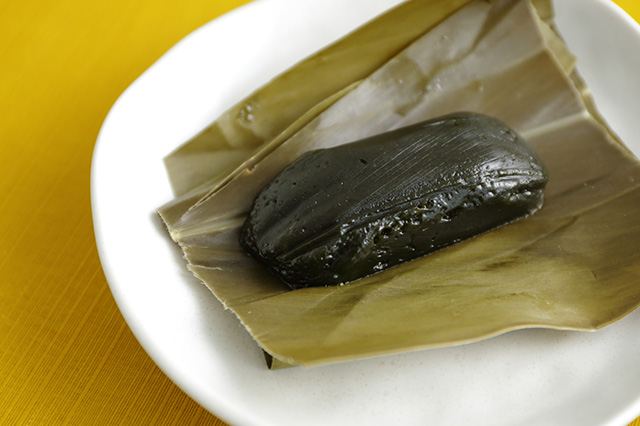
Kashamochi is a traditional food made by combining mugwort and mochi (rice cake), kneading in brown sugar and sweet potatoes, and then steaming the mixture wrapped in the leaf of the kasha plant (Alpinia zerumbet, known as shell ginger). It is characterized by the fragrant aroma of mugwort, the sweetness of brown sugar, and a chewy texture.
A specialty product of Amami Ōshima in the Kyushu region, kashamochi is also known locally in the Kyushu dialect as fuchi mochi or futtsu mochi (“fuchi” referring to mugwort). The main ingredients are brown sugar, mugwort, and sweet potatoes, though red beans (azuki) are sometimes included as well.
Kashamochi is still commonly eaten at home today, often served during seasonal festivals or taught in home economics classes at local schools. It is also popular as a regional souvenir from Amami.
History
In the Amami region, mugwort has long been abundant and has traditionally been used as a medicinal herb—boiled for consumption or used for its deodorizing and antibacterial properties. The kasha leaf (from the shell ginger plant, Alpinia zerumbet, a member of the ginger family) is also believed to have antibacterial and insect-repelling effects. It grows widely in the Amami region and is used not only for wrapping kashamochi but also for wrapping rice balls.
Kashamochi is a sweet that reflects the wisdom of the local people, who made use of readily available natural ingredients with beneficial properties such as mugwort, brown sugar, and kasha leaves. There is even a local expression that compares harmonious relationships to "mochi and kasha leaves," referencing how well the sticky mochi adheres to the leaf and how the combination of ingredients enhances the flavor.
Traditionally, kashamochi was made at home during seasonal festivals such as the old lunar calendar's March 3rd and May 5th celebrations, as a wish for children’s health and growth. It was also shared with relatives and served during important village events. Mugwort was believed to ward off evil, and the custom of gifting kashamochi to relatives stems from this belief.
While it was originally a seasonal treat, kashamochi is now enjoyed year-round. In spring, freshly picked mugwort is often frozen for later use, and the mochi is wrapped in kasha or gettō (shell ginger) leaves. Today, kashamochi is a popular everyday snack in the region.
Preparation Method
First, rinse the mugwort (yomogi) thoroughly in water to remove any dirt. Then, blanch it briefly in boiling water with a small amount of baking soda. After boiling, soak the mugwort in water overnight to remove bitterness. Drain the mugwort and blend it with boiled sweet potatoes in a mixer or food processor to create a smooth paste.
Next, add brown sugar, glutinous rice flour, and water to the paste and mix thoroughly until the dough is well combined. Take cleaned kasha leaves (about 20 cm long) and wrap the dough in them. Steam the wrapped dough in a steamer for about 20 minutes.
As the mochi steams, the gentle fragrance of the kasha leaf infuses the dough, enhancing the flavors of the mugwort and brown sugar. When eating, remove the kasha leaf and enjoy only the mugwort mochi inside. If the mochi becomes hard, it can be softened again by lightly steaming before serving.
Text adapted from the English Wikipedia article Kashamochi by its contributors, licensed CC BY-SA 4.0.
Dish data: Ministry of Agriculture, Forestry and Fisheries (MAFF), “Uchi no Kyodo Ryori” (Our Regional Cuisines) database, used under the Public Data License (PDL1.0); translated and adapted from the Japanese original.