Izushi 飯寿司
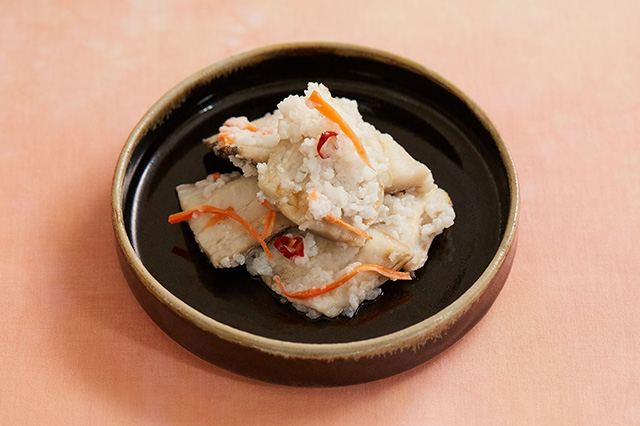
| Prefecture | Hokkaido (北海道) |
|---|---|
| Region | Hokkaido |
| Japanese name | 飯寿司(いずし) |
| Reading | Izushi |
| Home area | All over the country. |
| Main ingredients | And I'm going to show you some examples of this. |
History and Origins
"Susaki" will put fish and vegetables in a bowl and then add to the lye. One of the features is that at the time of the first snowfall, what was built in the fisherman's house was born and is produced in different regions. In particular, because they are cheap and stable for almost a year, they are familiar with the people of Hokkaido. On the Hokkaido coast, many quacks are caught in spring when food is gathered and in autumn when eggs are gathered.
When It Is Eaten
"Susame, made of low-heat enzymes," is soaked in late autumn and early winter, and is rooted in the region as a traditional winter preserve. At one time, every household was soaked in it, and I often ate sushi, which was soaked in late fall, in New Year's time. And there are many opportunities for the day of Harre, where family and relatives gather together.
How It Is Eaten
I put rice, fresh fish, vegetables, and rice in barrels, then put them in heavy stones, and put them in them, and fertilize them. The raw fish that has been boiled and salted are salted out with water, but this salt-freeness is said to be quite important when it is decided to taste. If you cut out too much salt, it doesn't taste good or save, but if it's too much, it can get too salty. Compared to other "unbled," they have a mild smell, since they can be soaked at low temperature for short periods. The sourness of rice and the acidity of lactate is balanced and is preferred both as a meal and as a wine boil.
Recipe
Ingredients
- 0.6 kg hatahata (sandfish) (小)
- 0.25 kg daikon radish
- 25 g carrot
- 10 g ginger
- 5 g koji
- 20 g cooked rice
- 10 g salt
- a pinch sugar
- 20 ml sake
- 120 ml vinegar
- bamboo leaves, to taste
Method
- The hataka takes its head, replaces water many times and cleans it. Five times as thin as a thin vinegar, so I can pack it up a day and get some water.
- I'll cut the carrots and carrots down.
- Wash the barrels clean and shake the wine inside.
- I'll spread the leaves of the bush inside the barrel, put roots, carrots, salt, sugar, and place the honey in the barrel, but I'll put it in a box. I repeat it like there's no gap.
- I'll put a heavy stone on it, sleep in a cold dark place, and cut the water off when I'm dry. double this amount and we'll keep it covered for about 40 days.
More About Izushi
Isozo, Ichio, and Sakura are not made by pluripotent lye.
Overview
Vegetables are characteristic, and sushi exists.
There is a densely populated area on the northern coast of Japan and in the cold regions of Hokkaido, but it is also located in Western Japan. Often made in cold regions is because the temperature is below freezing point for at least a month when the extract is cold, and decay is more likely to occur.
The fish used are a lot of honey, honey, sea cucumbers, nicin, Samma, Kinki, and curry. Vegetables use cabbage, root, carrots, peppers, onions, and sunglasses. Some of them were used for fruit, such as akebees and alfalfa.
Compared with other unspoiled foods, it has a shorter period of hypothermia, so its scent is mild and the balance between the sweet taste of rice and the acidic acid of rice is better.
History
In addition, by the 15th century, it was developed into a "Smushi sushi" that was put in vegetables and cucumbers and then fertilized in a short period of time.
Inne, an indigenous people of Hokkaido, didn't have a culture of American food, so it wasn't in the Ainese food. For this reason, it is thought that the Japanese who pioneered at Hokkaido brought it in.
Sushi, which is known as Hokkaido, is said to be faithful to the methods and prototypes of the time he entered.
Name
There are many theories as the source of the word, but none of the evidence has been found to be significant. Here is an example of the theory.
The fact that fish are soaked in rice and digested is enough to make it "somi which is fermented with rice" or "Saki." I call fish "ooh," so I'll say, "a little sushi." This changed, and I'm like, "I'm not."
Note Point
For example, in Akita Prefecture, where you need to be careful when you make it, to keep it from touching the air, you need to be careful about botulin poisoning. (And if you have some advanced lactate when you dip fish into it, you will avoid breeding botulism.)
Text adapted and translated from the Japanese Wikipedia article 飯寿司 by its contributors, licensed CC BY-SA 4.0.
Dish data: Ministry of Agriculture, Forestry and Fisheries (MAFF), “Uchi no Kyodo Ryori” (Our Regional Cuisines) database, used under the Public Data License (PDL1.0); translated and adapted from the Japanese original.