Home / Hokkaido / Tokishirazutokizakenoyakizuke
Tokishirazutokizakenoyakizuke トキシラズ
| Prefecture | Hokkaido (北海道) |
|---|---|
| Region | Hokkaido |
| Japanese name | トキシラズ/トキ鮭の焼漬け(ときしらず/ときざけのやきづけ) |
| Reading | Tokishirazutokizakenoyakizuke |
| Home area | All over the country. |
| Main ingredients | Toxillaz. |
History and Origins
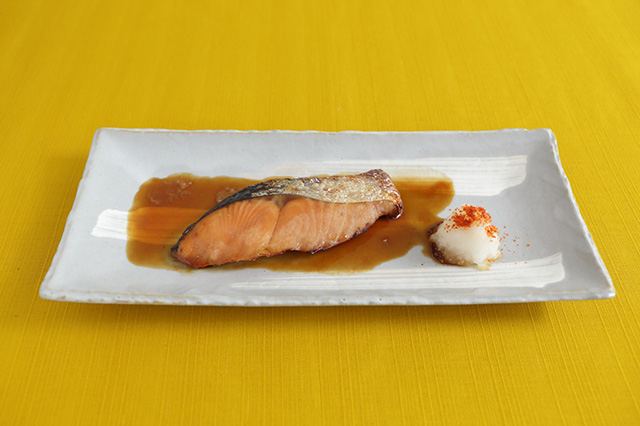
The moss that goes back to the coast of Hokkaido, from autumn to early winter, for eggs, is called "The Fall Saxe." But the lyre that went back during the season between spring and summer, is called "The Toxicus." In Chinese characters, it is named for "time unknown" or "time unknown" or "timeless" or "fish" that takes place without knowing the time. What's different from the normal autumn cherry in autumn is where you were born. While autumn sakes are born in a river of Hokkaido, the Toxyraz is caught on the shores of Hokkaido when born and playing in the Amur River in northern Russia. It is said that the Toxyras, caught in their youth, are quite tasty, since they are not ready for eggs yet, and that fat and nutrients are found in their body rather than in eggs and albino. The fat stain is very good, and the softy toxyraz is a valuable pumpkin and is popular throughout the country. "Burn of Toxyraz" is one of the typical Hokkaido native dishes used by Toxyraz. I've always been behaved up to eat at home. At the festival of the Tadashi, celebrated in June, the family was making and eating "toxylas baking" and "red."
When It Is Eaten
The fat "Toxy Laps" that comes out about June is a treat for this season. It's sold as a luxury item, but it's available locally, even at supermarkets.
How It Is Eaten
I'm going to dip the "Toxyraze" baked on fried pans and grills, into a taste juice mixed with soy sauce, oil, garlic, and wine. If you dip it in half a day, you can eat it, but if you dip it in for a night or so, it's better to taste it. It's said it tastes good. It's good for rice, and it's popular for children to have no supper. It's also liked by both adults and as a drinking bowl.
Recipe — Serves 4
Ingredients
- 4 slices トキシラズ
- to serve: 野菜
- 3 tbsp soy sauce
- 2 tbsp sake
Method
- Put the flavors together in a plastic bag, put a saxophone in it, close your mouth, and dip it in for about half a day.
- I'll burn the salmon with a grill. Several times along the way, we'll finish the gravy with soap and then we'll have our seasonal vegetables wiped.
More About Tokishirazutokizakenoyakizuke
The Kudangsaws are a year-old plant in the Hijichi Fungangsaw family. (A set of beat patterns improved as a leafy vegetable). I'm sorry, I'm sorry, I'm sorry. For the Swiss cultured, there is a common name for the Japanese yang-dang-saw. It's the same kind of citrus and table beat.
Name
The Japanese name for hudangsaw comes from writing in kanji, "long grass" and being able to grow very hot and cold through four seasons, and can rip leaves and harvest them for almost a year. In Japan it is also known as Swiss Chad, and it refers specifically to the type of leaf that has thick leaves that shrinks to the leaves. In English, it's called chard, in French it's tweet, and in Italian it's called bietola. In Spanish, it's called "selagos esterga."
The "All Agriculture Book" published in the former decade 1697 contained the name" in its origin, "for there are always four seasons," "The Veterinary of During Life." It's grown in many places as traditional home-saving vegetables, similar to spinach, but it can be used regardless of the relative season. There's also a word for "nami."
History
It's a vegetable in spinach that has been modified from the Mediterranean coast to the Caspian Sea area and from the Percia region as a leaf plant.
We are told that Hudangsaw was grown on the island of Siberia about 1,000 B.C., and there are records of it growing from the second to third century C.E. by Greeks and Romans. At that time, they were divided into two categories by the faint color of leaves. They called the dark black fundaws and the pale colors white fangsaws. China has records grown around the sixth century, and there are also records of the fact that it was boiled in Tangswright, in 656 - 660. In 16th - century Switzerland, white, red, and dark - green varieties are found on the broad stem.
Transmission to Japan is thought to have been transmitted from China in about the 17th century because of the description of the Edo book "The Morning Book" (in 1697) as well as the term "Touhusha" in its description. In Meiji's first year, beautiful species of red and yellow-looking flowers were imported as kaensaisai (Beats) but are now not seen at all.
Form
The herb book of first or second graders. The whole stock is hairless, and its length, including leaves, is about 30 centimeters (cm) in length. The root is straight root and doesn't expand. The growth of the side roots is high, and the roots spread to relatively shallow areas. It's a root leaf, with a leaf about 10 centimeters wide, and has an egg shape of 15 - 30 centimeters long, or long - ovum - shaped flesh. The leaves are deep green, white, red, yellow, orange, and so on. The leaves are broad and polygamous, but the Oriental species in general tend to be narrow.
The season begins in the first summer, the chrysanthemum begins, the stem grows about a meter long, and the cone flower is placed at the top. The flowers have no petals, and they wear five flowers, five male and one female. Fruits are wrapped in thick, thick, convex conch. The number of chromosomes is 2n=18, 19, 20, 27, 36, 42, 45.
Type
There are few different species, and in Japan, there are two main categories: the palethontice and the white stem, but they don't handle the seeds with the exact name. When you travel to Japan, you will see that the ones that are present are small and have a long half-circuited leaf and have a light green and smooth shape.
The original species of the Japanese albino stem are not clear, but in Europe and North America, they are classified into many species. Of these, it is thought that the French-born Whitele Lefèvs was introduced to the early Meiji. The alabaster has large leaves and broad leaves, white, white, white, white, and very resistant. The species found in part of the Osaka grown center and in part of the Kumamoto Prefecture have these traits. There are other species, such as Swiss Chadh Swiis Chard, but in the color of the leaves, they are distinguished from the native alchemy of the sea albino.
Cultivation
The cultivation period can be harvested in 2 - 3 months, the production in first summer, 5 - June, and the method of harvesting from late fall to spring. In spring and fall, there will also be plant transplantation, which will grow in the field directly from the seeds. There is generally a direct growth, and transplanting is mainly used by the sea albino. Seeing the growth, we take compost and grow it. It's also easy to grow in a vegetable garden, even in a bowl or a planner.
The germination temperature is 9-35 degrees, and it's near 25 degrees, and it's the best sprouting. The growth temperature is 15 to 20 degrees Fahrenheit, but it is very strong in heat and is easily cultivated throughout the year without too much concern for the relatively sunny sun. It's very dry and resistant and is considered to be as good as lettuce and sunggi. Protomization and duplicity are promoted if a branch that has grown to a certain degree is exposed to high temperature. The soil is suitable for growth and has pH 6.0 - 6.6 soil growth as best as possible. The soil doesn't need to be cultivated deeply, but it keeps the compost when it is boiled, but it grows well even when there are fewer fertilizers. If you have a runoff, your upbringing will be bad. There are complications and plants grow in the same field for over a year.
In direct growing, you can grow them by cutting or tearing them apart, and you can grow them between a few degrees, and you can do anything but winters. The seeds are hard to sprout, and the three are massed into pieces. Seeds can be soaked overnight and then spread easily, covered with two to three times the thickness of the seed, and thoroughly watered. Since it requires humidity before it sprouts, it increases the rate of germination if the soil is not dry. After the sprout, we divide it into two-thirds and then we pull it between them. For the first time, the subtracting is five centimeters apart when the leaves are 1 - 2 and the second three - four, ten centimeters apart, and the third time is 20 centimeters apart when the leaves are 5 - 6. In the harvest, the base of the stock is about 35 to 40 centimeters. Also, you can use a vegetable while it occurs at this time.
In transplanting plants, as well as inverting and growing seeds, growing them in a slow way, but when the leaves are four or so between the first and the second time, it is the appropriate time for planting them. The planting is done for about 20 centimeters between the shares, but in the harvest, it is done between 35 - 40 cm.
Since the grass has turned ten centimeters, we've done a little compost. Vegetables are sufficient for nitrogen fertilizers and are provided according to growing conditions. Middle-growth is done by cutting herbicides, but it's not allowed to pull dirt. It's best to harvest it while you're young, because when you're 15 to 20 centimeters tall, it's a harvest season, and when it's slow, it's a leafy day, and it's bitter and bitter. In the harvest, the harvest continues to be harvested from the larger lower leaves.
There are insects and disease and disease caused by phosphorosis and disease, and disease and disease from insects. Sympathy can occur early in the spring and can be caused by small spots in the leaf outline and may be severely damaged. Since the dying disease occurs when the leaves of the sprout open and the soil is too damp to produce the disease, the sprouting occurs and the water is grown in very good soil. There are few insect pests, but there are times when insects, beetles, beetles, and caterpillars grow. If the plant is damaged, such as a beetle, or something like that, either capture the worm or pour the medicine to the stock.
Although it has been grown as a substitute substitute for spinach, which is too hot and dry for heat, in the vicinity of the city, is scarce in summer, in recent years the demand for the produce has dropped because of the increased production of spinach. On the other hand, you can harvest in the summer when you have a shortage of vegetables and you don't choose any soil, so you're popular in the garden. The yinhud dunso is sold in a seed shop under the names of Swiss Chad and Bieltra, and is grown as a garden.
Eat.
The leaves taste like spinach, and they are used to make soups, soups, soups, soups, and stews. Since there is a peculiar blue smell, cooking is usually done with a low-seat, so when you cook it, it is as common as the spinach, when you pull out the lye and then use it for cooking. Fat leaves can be eaten by boiling or boiling cream, butter roasting, and so on. Okinawa Prefecture is used as a winter vegetable, and it is made into a taste-smelled soup called Sooey or Unbsy.
Since the Swiss leaf is colorful, it can be used in addition to salads and dishes. Redchard's young leaves, which are used for raw food, are spread by such products as baby-loaf and mini-vier tigers and are often used as raw salads along with lambstas.
It is highly nutritious and is classified as green and yellow vegetables and is rich in beta-carotins, vitamins B1, vitamin E, calcium and iron. Among other things, the potassium and iron are very rich. It's rich in vitamins B6, vitamins K and food fiber. The stems are colorful and have red, orange, yellow, white, green, and other species, which are due to betaline pigments, a kind of polyphenol.
For drugs.
It's used for private use. It's also useful for intestinal and constipation. It is also said that eating too much is not good because of the cooling effect of the body.
Text adapted and translated from the Japanese Wikipedia article フダンソウ by its contributors, licensed CC BY-SA 4.0.
Dish data: Ministry of Agriculture, Forestry and Fisheries (MAFF), “Uchi no Kyodo Ryori” (Our Regional Cuisines) database, used under the Public Data License (PDL1.0); translated and adapted from the Japanese original.