Oiri おいり
| Prefecture | Tottori (鳥取県) |
|---|---|
| Region | Chugoku |
| Japanese name | おいり |
| Home area | Eastern Area |
| Main ingredients | rice, water. |
History and Origins
"Chee" is a candy prepared at home so as not to waste leftover food. In the past, I heard that in the families of the Hajitas, they washed the leftovers and fried them (I want them to have dry, dry rice) and made a mess. It is said that "this roasting" comes from a familiar name. There were other families that were made by mixing not only the leftover food but also the food they had at home. It's a family dish born out of a feeling that we don't waste food.
When It Is Eaten
The sweets which are essential for the festival. In the city of Tottori City, however, it remains only a few, and is now designated as the "Sendure of Service" in the province's non-citizen culture. When I poured the sink, I was added to the sink, along with the flowers of the cherry and the peach, as well as the "sit." Tottori Prefecture often celebrates a festival in the old calendar, and the grand festival in the province will be held in April. So it can be sold and eaten from January or February to April to the old calendar.
How It Is Eaten
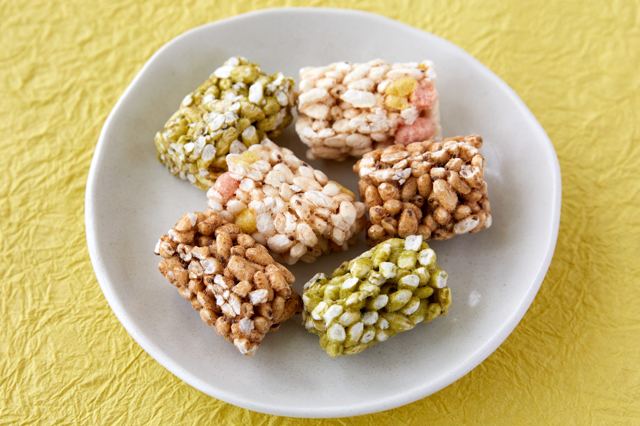
The process is simple, roasting dried rice, and forming round while it is hot with water cans. When making "sit" in the home, the original" has been made according to the ingredients in the house and the tastes of the eater. (It is recommended that you add some pepper or juice when you cook water candy.) The raw materials are varied by the maker, and they are used by the pale rice, white rice, flour, rice, and candy. But now it's common to buy in supermarkets and Japanese candy stores. Although the traditional recipe doesn't color it, there are also tailors that produce a "knit" with a mixture of pink or green.
Recipe
Ingredients
- 500 g white rice (rice)
- 2 tbsp mochi
- 260 g mizuame syrup
- 160 g sugar
- 1/2 tsp salt
- 40 ml water
Method
- White rice or brown rice) will be served as candy.
- I'll cut it into three-millimeter cubes if it's small and hard.
- We cook the pot with water cans, sugar, salt and water. When the bubble is small and the bow is skimmmed to pull the thread, you can put in a piece of porter rice and two cups and stir quickly.
- In the meantime, add salad oil to the table and then seal it to the right size. I'm not sure if I'm going to eat it.
- It's not a tight grip when it's hot, but it's rolled to roll with the flats of your hands. If it gets cold, I'll mix it with a fire to melt the candy, but be careful when it gets burned. You may add some of the soup you like, but you may add some of the candy when boiling. In that case, put the candy in after it's boiled. If you put it in first, the foam will rise and you won't be able to judge the boiling or boiling. Pong means to expand rice with a processing machine. Whether you have a manufacturer make rice or brown rice or not, buy the materials that are processed at the store. (If you're buying, you're not fit for something that's already stuck on the surface.)
More About Oiri
The condo is one of the products of Kagawa Prefecture, particularly from the midwestern region, in the east of the Ehime Prefecture. It's sold mainly as sweet toppings, such as soft cream, and as wedding drawers.
It's about an inch in diameter. There are various colors, such as pink, green, white, sky, purple, orange, and so on. It feels like a thin shell outside, and as soon as you put it in the hollow, it melts. It is similar to the taste of a common dish, and sweet is modest.
The raw materials are mainly rice.
Uses
It's used as a topping for sweets, such as soft cream.
It's also used as a wedding kit for Kagawa Prefecture. Sometimes it is used as a gift to attend the wedding feast or as a gift to the neighbors of the house in which they have been married. In that case, a small, circular - shaped candy called "Schools" is often presented at the same time. The sweets are, that is, they have a flat surface, and the colors and tastes are the same. The little sweets are presented in a red-white makeup box.
It's called lentils, and it's used as a drawer to wrap the bowl in a plastic bag and then put it in a red-white makeup box.
Source
From the simple taste itself, there are also some souvenirs sold, such as the harbinger, the harbinger, and the harbinger, which reproduces the color of the pastel hue.
Text adapted and translated from the Japanese Wikipedia article おいり by its contributors, licensed CC BY-SA 4.0.
Dish data: Ministry of Agriculture, Forestry and Fisheries (MAFF), “Uchi no Kyodo Ryori” (Our Regional Cuisines) database, used under the Public Data License (PDL1.0); translated and adapted from the Japanese original.